
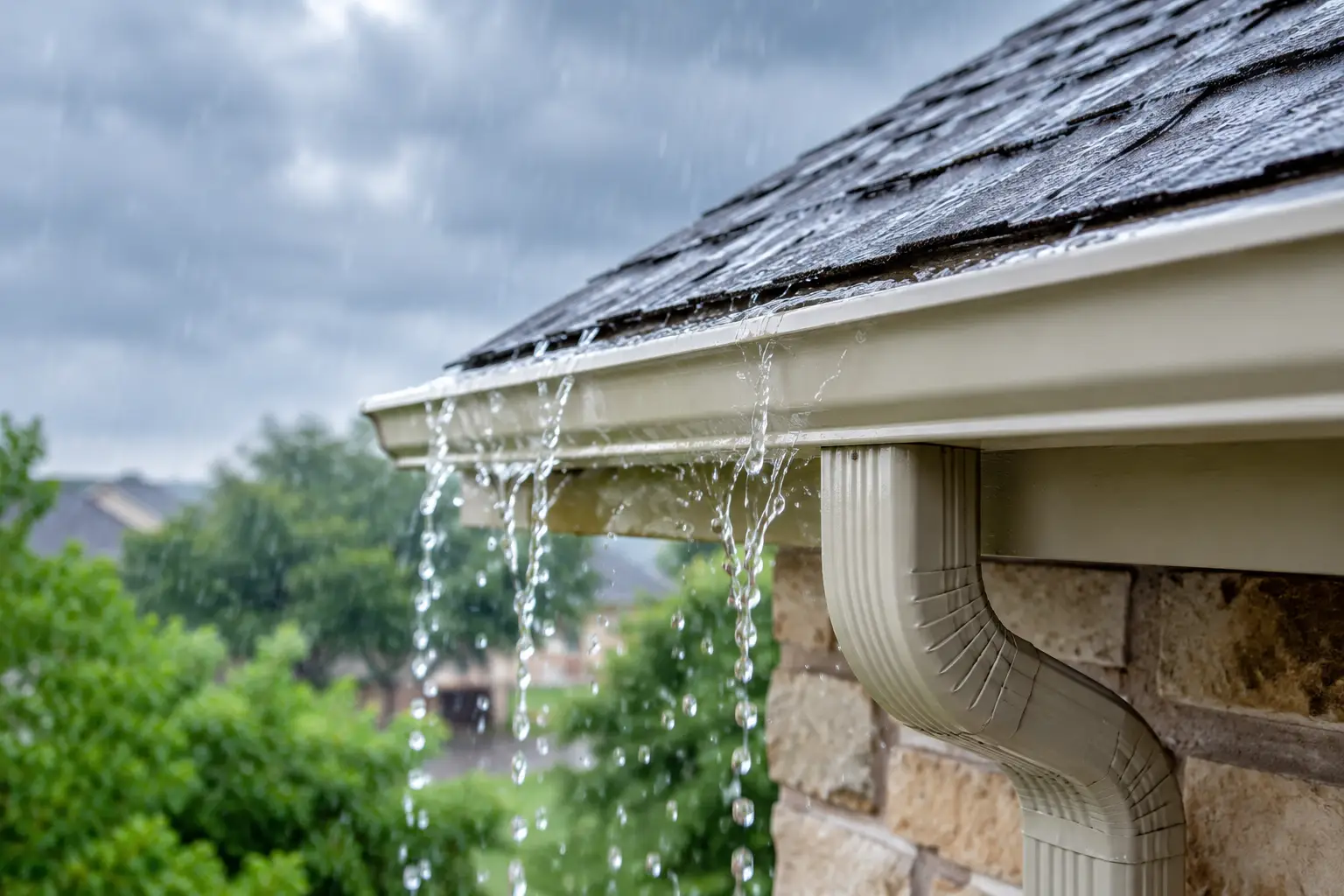
A fast-moving North Texas storm can drop enough water on a roof to expose every weak point in its drainage system. When runoff spills over the gutter edge, pools near the foundation, or pours behind the gutter, the issue is more than a nuisance. Seamless gutters for heavy rain help direct that water where it belongs, protecting siding, landscaping, fascia, and the structure beneath your home.
For Dallas-Fort Worth property owners, gutters need to do more than handle an ordinary shower. They need to perform during sudden downpours, long spring storms, and the wind-driven rain that often follows hail. The right system comes down to proper sizing, thoughtful downspout placement, secure installation, and a clear look at how water moves across your specific roof.
Why Heavy Rain Overwhelms Ordinary Gutter Systems
Most gutter overflow is not caused by one dramatic failure. It is usually a combination of small problems that become obvious when rain falls hard: a gutter that is too narrow, downspouts that cannot move water quickly enough, poor slope, loose hangers, or debris blocking the outlet.
Roof size and roof shape matter as much as the gutter itself. A large roof plane sends a significant amount of water toward one eave. Valleys concentrate runoff even more, creating a rush of water that can shoot past an undersized gutter or overwhelm a single downspout. A steep roof may shed water faster than a lower-pitched roof, especially during a hard storm.
North Texas homes also deal with wind. Water can be pushed over the front lip of a gutter, while branches, leaves, and roof granules collect at corners and downspout openings. If the gutter system has not been designed for those conditions, even a relatively new installation can overflow.
What Seamless Gutters for Heavy Rain Should Include
The name describes how the gutter is made. Instead of joining together many pre-cut sections along a roofline, a contractor forms continuous lengths on site to fit the home. Fewer joints along the run means fewer locations where leaks can develop over time.
That construction is valuable, but it is only one part of a system that can manage serious rainfall. A properly planned installation should account for the gutter profile, capacity, drainage path, attachment method, and the roof areas sending water into each section.
The Right Gutter Size
Five-inch gutters are common on many homes, and they can work well where roof drainage is modest. For larger roof areas, steep slopes, long gutter runs, or areas below valleys, six-inch gutters often provide a meaningful increase in capacity. They hold more water and give fast runoff more room before it reaches the outer edge.
Larger is not automatically better for every property. Oversizing a system without correcting poor slope or insufficient downspouts will not solve the underlying problem. The goal is to match the gutter size to the roof's water load, not install a one-size-fits-all product.
Downspouts That Keep Water Moving
A gutter can only hold water briefly. Downspouts do the real work of moving it away from the roofline and foundation. Too few downspouts, undersized outlets, or long runs feeding one location can cause water to back up during heavy rain.
Larger downspouts, often 3-by-4-inch rather than 2-by-3-inch, can improve drainage on high-volume sections. Placement matters just as much. A roof valley that sends water into the middle of a long gutter run may need a nearby outlet instead of relying on a downspout at the far end.
Discharge should also be planned carefully. Water should drain away from the foundation without creating erosion, soaking planting beds, or sending runoff toward a walkway or neighboring property. Extensions, underground drainage, and grading improvements may be appropriate depending on the site.
Correct Pitch and Secure Hangers
Gutters need a subtle slope toward each downspout. Too little pitch leaves standing water and debris inside the channel. Too much can look uneven and may not solve capacity problems. The slope should be measured and set for the length of the run, not guessed from the ground.
Secure hangers are especially important in storm country. A gutter filled with water is heavy, and wind adds more strain. Properly spaced fasteners attached to sound fascia help the system stay aligned instead of sagging or pulling away when it is needed most.
Before installation, the fascia and roof edge should be inspected. Soft wood, hidden rot, damaged drip edge, or active roof leaks should be addressed rather than covered up. A gutter installation is an opportunity to identify these issues before the next storm makes them worse.
Gutter Guards: Helpful, but Not a Cure-All
Gutter guards can reduce the amount of leaves, twigs, and debris entering a gutter. For homes with mature trees, they may cut down on cleaning and help keep downspout openings clear. They are not a promise that maintenance will never be needed.
During intense rain, some guard styles can affect how quickly water enters the gutter. The right option depends on roof pitch, tree coverage, the type of debris around the property, and the volume of water coming off the roof. A good contractor will discuss that trade-off instead of treating guards as the answer to every drainage concern.
Even with guards installed, homeowners should watch the system during a strong rain. Overflow at a valley, water running behind the gutter, or a downspout that drains slowly are signs that the system needs attention.
Signs Your Current Gutters Are Undersized or Failing
You do not have to wait for visible interior damage to evaluate your gutters. Look for water spilling over the edge during rain, stains or peeling paint on the fascia, sagging sections, rust, separated joints, and soil washed away near the foundation.
Other warning signs are more subtle. Mildew on siding, recurring mulch displacement, standing water near the home, or a basement or crawl-space moisture problem can all point to poor roof drainage. On commercial properties, overflowing gutters can create slippery entries, damage exterior finishes, and complicate maintenance around the building.
If a problem appears after a hail or wind storm, the roof should be checked at the same time. Storm damage can affect shingles, flashing, vents, fascia, and gutters together. Repairing only the visible gutter issue may leave the source of water intrusion unresolved.
Installation Quality Matters as Much as Material
A gutter system is only as dependable as its layout and installation. Contractors should measure roof sections, locate valleys, assess existing downspout capacity, inspect the fascia, and identify where runoff can safely discharge. That assessment is particularly important on homes with additions, complex rooflines, or previous drainage modifications.
Material quality matters, too. Aluminum gutters are a popular residential choice because they resist rust and are available in colors that complement the home's trim. Thickness, finish quality, and correctly matched components all affect long-term performance. For commercial buildings or larger structures, drainage design may require a more specialized approach based on roof type and building conditions.
At Reilly Roofing and Gutters, the gutter inspection can be part of a broader exterior assessment. That is useful after severe weather, when the roof edge, gutters, and drainage system may all have been affected. Homeowners receive a clear explanation of what is working, what is not, and what should be addressed first.
A Practical Way to Prepare Before the Next Storm
The best time to evaluate drainage is before storm season, not while water is already crossing the threshold. Have the roofline, gutters, downspouts, and discharge areas inspected. Clear obvious debris, confirm that downspouts carry water away from the home, and pay close attention to roof valleys and corners where overflow has happened before.
If you are replacing a roof, it is also a smart time to evaluate the gutter system. New roofing materials deserve a drainage plan that protects the investment from the first storm. A properly sized, well-installed gutter system gives heavy rain a controlled path off the property, so your home is better prepared when North Texas weather turns without warning.